


Vietnamese Bone Broth: My 10-Hour Golden Elixir

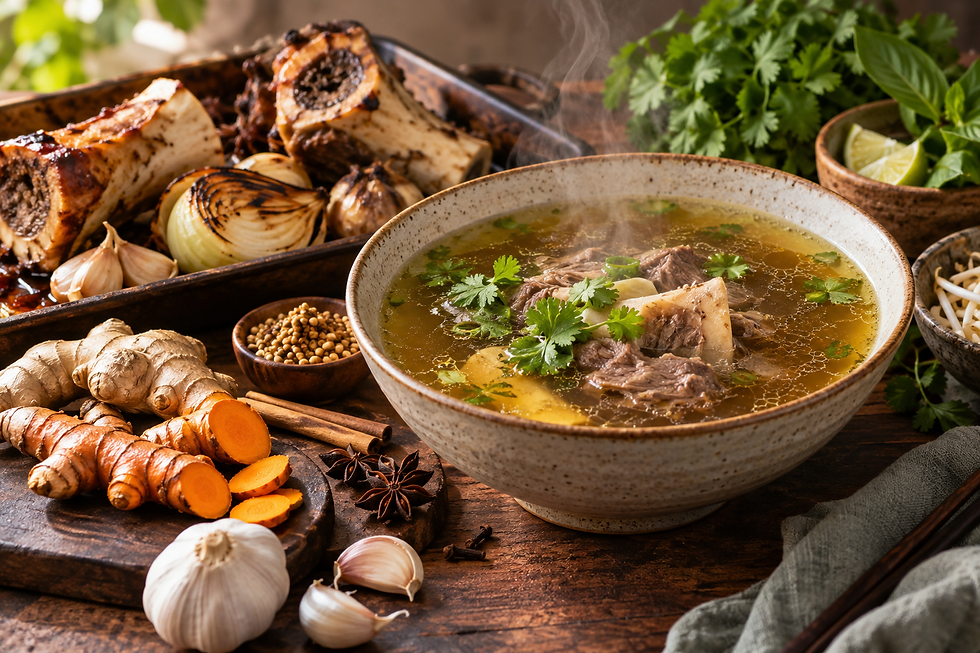
There is something deeply satisfying about making bone broth the old-fashioned way.
You take something incredibly simple — beef shin bones, ginger, onion, garlic, turmeric and spices — roast everything until it is beautifully caramelised, cover it with water and then leave it to gently simmer for hours.
What emerges 10–12 hours later is completely different: a rich, fragrant, golden broth that is warming, deeply savoury and packed with compounds extracted from the bones and connective tissue.
My version is inspired by the aromatic flavours of Vietnamese pho, but I add fresh turmeric and garlic to turn it into an even more intensely flavoured everyday broth.
I make a large pot and drink it by itself, use it as the base for soups, or add meat, vegetables, herbs and noodles when I want a complete meal.
Why use beef shin bones?
Shin bones are particularly good for slow cooking because the area contains bone, marrow and collagen-rich connective tissue.
During a long, gentle simmer, collagen from connective tissue breaks down into gelatin. That is why a really good homemade broth often turns into a jelly in the refrigerator.
That wobble is exactly what I want to see!
Gelatin provides amino acids including glycine and proline, while any meat left around the bones contributes additional protein and amino acids.
The exact nutritional composition varies enormously depending on the bones, the amount of meat and connective tissue, how much water you use and how concentrated you make the final broth.
The aromatic powerhouse
I don't just throw raw bones into water. Roasting the bones and charring the aromatics first makes an enormous difference to the flavour.
Ginger
Ginger contains bioactive compounds including gingerols and shogaols. It has been studied particularly for its effects on nausea and digestion, as well as its antioxidant and anti-inflammatory properties.
It also gives the broth that unmistakable warming kick.
Turmeric
Fresh turmeric provides curcuminoids, including curcumin.
Curcumin has been extensively researched for antioxidant and anti-inflammatory activity. However, the amount absorbed from a bowl of broth is difficult to predict, so I think of turmeric as a fantastic culinary ingredient rather than treating the broth as a therapeutic dose of curcumin.
A little freshly cracked black pepper must be added to activate the curcumin, multiplying its power by 2000 times!
Garlic
Garlic contains organosulfur compounds. Crushing or chopping fresh garlic initiates the formation of compounds such as allicin.
Garlic also brings another layer of savoury depth to the broth.
Onion
Charring the onion gives the broth sweetness and complexity. Onions also provide various plant compounds, including flavonoids such as quercetin.
Vietnamese-style spices
3 Star anise, cinnamon sticks, 15 cloves, 5 cardamom pods and coriander seeds completely transform an ordinary beef stock.
They create that wonderfully aromatic fragrance associated with Vietnamese pho broth — warm, spicy, slightly sweet and incredibly comforting.
My Vietnamese-Inspired 10-Hour Bone Broth Recipe
Makes: approximately 3–4 litres, depending on reduction
Ingredients
2–3 kg beef shin, marrow and/or joint bones, preferably with some connective tissue attached
2 large onions, halved
1 large piece of fresh ginger, roughly 10–15 cm, halved lengthways
1 whole bulb of garlic, halved
1–2 pieces fresh turmeric, sliced or halved
3–4 star anise
1 cinnamon stick
4–6 cloves
1 tablespoon coriander seeds
1 teaspoon black peppercorns
3–4 litres filtered water, or enough to cover the bones
1–2 tablespoons fish sauce, optional
Sea salt to taste
For serving, I love freshly chopped coriander, parsley, Thai basil, spring onion and lime.
1. Roast the bones
Heat the oven to 220°C / 200°C fan.
Spread the bones over a roasting tray and roast for approximately 30–45 minutes, turning once, until deeply browned.
Don't be frightened of colour. Browning creates much of the extraordinary savoury flavour in the finished broth. Avoid actually burning them, though.
2. Char the aromatics
Add the onion, ginger, garlic and turmeric to the tray for roughly the final 15–20 minutes, or char them separately under the grill.
You want browned, blistered edges rather than completely blackened vegetables.
3. Toast the spices
Place the star anise, cinnamon, cloves, coriander seeds and peppercorns in a dry pan.
Toast gently for a minute or two until beautifully fragrant.
Don't burn them.
4. Start the broth
Transfer the roasted bones, charred vegetables and toasted spices into a large stockpot.
Cover everything with cold water.
Slowly bring it towards a simmer.
As foam and impurities rise to the surface during the first hour, skim them away with a spoon.
5. The important part: LOW and SLOW
Turn the heat right down.
The broth should be at a very gentle simmer — not a furious rolling boil.
Leave it for around 10–12 hours, checking occasionally and adding a little hot water if necessary to keep the bones submerged.
This long cooking time helps extract gelatin and flavour from the collagen-rich tissues surrounding the bones.
Your kitchen will smell incredible.
6. Strain
Carefully remove the large bones and strain the broth through a fine sieve.
Season at the end with sea salt and, if you like, a little fish sauce.
Let it cool promptly and refrigerate it.
Once cold, a collagen-rich batch may become beautifully gelatinous.
You can also remove some or all of the solidified fat from the top depending on how rich you want it.
What's Actually in a Bowl of Bone Broth?
This is where it's important to separate genuine nutrition from some of the more extravagant claims made about bone broth online.
There is no single nutritional value for homemade bone broth.
A light broth made from mostly bare bones will be completely different from a concentrated broth containing marrow, joints, cartilage and meat.
A typical serving may provide:
Nutrient/compound | Why it's interesting |
Protein | Supports maintenance and repair of body tissues |
Gelatin | Produced as collagen breaks down during cooking |
Glycine | An amino acid abundant in collagen/gelatin |
Proline | Another important collagen-associated amino acid |
Glutamate & other amino acids | Contribute nutrition and the broth's deep umami flavour |
Minerals | Small and highly variable amounts may enter the broth |
Fat | Depends heavily on marrow content and whether the fat layer is removed |
Gingerols/shogaols | Bioactive compounds from ginger |
Curcuminoids | Bioactive compounds supplied by turmeric |
Organosulfur compounds | Associated with garlic |
But isn't bone broth full of calcium?
Surprisingly, not necessarily.
One common misconception is that simmering bones automatically creates an exceptionally calcium-rich drink. Research suggests the mineral content of bone broth can actually be relatively modest and varies considerably according to preparation.
So I wouldn't rely on bone broth as my primary calcium source.
Its nutritional appeal is more about the combination of fluid, protein, gelatin-derived amino acids, food-derived bioactive compounds and an incredibly nutrient-dense whole-food meal when meat and vegetables are added.
What are the potential benefits?
1. A useful source of collagen-derived amino acids
Long cooking converts collagen-rich connective tissue into gelatin.
Gelatin contains glycine, proline and hydroxyproline — amino acids associated with collagen.
However, drinking broth doesn't mean that collagen travels directly into your skin or joints. Your digestive system breaks dietary proteins and peptides down and the body subsequently uses those building blocks where they're needed.
2. An easy way to increase protein
A concentrated broth — particularly one containing meat — can contribute to daily protein intake. If I'm turning mine into a meal, I'll add shredded beef or another protein source rather than assuming broth alone provides enough protein.
3. Hydration
Broth provides fluid and electrolytes, making it an especially comforting drink in cold weather or when you simply don't feel like another glass of water.
Just remember that sodium can become quite high if lots of salt, stock cubes or fish sauce are added.
4. Warm and easy to eat
One of bone broth's simplest advantages may also be one of its best: it is warm, palatable and easy to consume.
Sometimes food doesn't need an exotic wellness claim to be valuable.
5. An extraordinarily versatile whole-food base
Instead of buying ultra-processed soup bases, I can make one huge batch and turn it into completely different meals throughout the week.
Add mushrooms and greens one day.
Add beef, herbs and rice noodles for a pho-inspired bowl another day.
Or simply warm a mug and drink it.
Make it into a complete meal
For a spectacular bowl, I add:
thinly sliced beef or shredded shin meat, rice noodles if I want carbohydrates, bean sprouts, spring onions, coriander, Thai basil, mushrooms or leafy greens, fresh chilli and a generous squeeze of lime.
Suddenly my broth becomes dinner.
Storage & food safety
Because this is a large pot of meat stock, cooling and storage matter.
Don't leave several litres of warm broth sitting at room temperature for hours. Divide it into smaller containers so it cools quickly and refrigerate promptly.
Use refrigerated broth within around 3–4 days, or freeze individual portions for later.
Bring refrigerated broth back to a thorough steaming temperature before serving.
If you don't have enough space in the fridge, you can preserve the broth simply by bringing it boil daily to keep it sterile - this is the old-fashioned way before fridges were even invented.
The Vortex verdict
For me, the beauty of bone broth isn't that it is some miraculous cure.
It's that a pile of humble bones, roots and spices can be transformed through time into something deeply nourishing and absolutely delicious.
Roast the bones.
Char the ginger and onions.
Toast the spices.
Then give it time.
Ten slow hours later, you have liquid gold.


Comments